How Khruangbin Writes Music: The Relay Race Model for Remote Collaboration
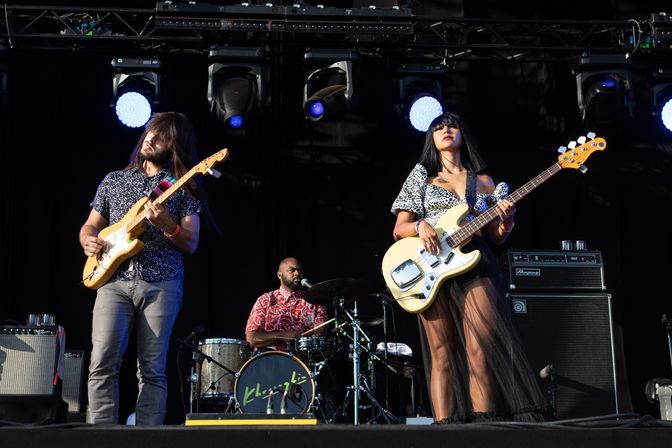
Photo Credit: By Alexander Kellner, CC BY-SA 4.0
“It’s kinda like a relay race when we write, but it’s cool because each of us gets to work on our own sections solo.”
— Khruangbin
Khruangbin writes music the way most remote producers wish they could. One person works, passes the file, the next person adds their part. No scheduling conflicts. No creative compromise from trying to do everything at once. Just focused solo work that stacks into something bigger than any one of them could build alone.
If you’ve ever tried to collaborate remotely on a track and ended up drowning in WeTransfer links, outdated stems, and “wait, which version are we on?” conversations, pay attention. This Houston trio figured out async collaboration years before the rest of us started using the word.
How Khruangbin Actually Writes Songs
Their process is deceptively simple. Here’s how a typical Khruangbin track comes together, based on what the band has described in interviews.
DJ starts with drums. Donald “DJ” Johnson records drum loops and rhythmic foundations. Sometimes these are full grooves. Sometimes they’re skeletal patterns that just suggest a direction. He sends them out to the other two.
Laura Lee and Mark work independently. This is the part that matters most. Laura Lee Ochoa takes those drum loops and writes bass lines on her own time. Mark Speer does the same with guitar. Neither is reacting to the other in real time. They’re each responding to DJ’s initial idea in isolation, bringing their own instincts to the table without the pressure of someone watching over their shoulder.
Mark arranges and layers. Once everyone has recorded their individual parts, Mark typically handles arrangement. He chops sections, layers takes, and shapes the raw pieces into song structure.
The band reviews together. Only after all that solo work do they come together and listen to what they’ve built. They make decisions as a group, but the creative heavy lifting happened asynchronously.
TIP
Notice what’s missing from this process: nobody is sitting in a room waiting for someone else to finish a take. Each person does their best work solo, then the pieces come together. That’s async collaboration at its core.
This workflow produced Con Todo El Mundo, Mordechai, and A La Sala. It got them Grammy nominations. It works.
Why This Workflow Breaks Without the Right Tools
Here’s the thing about Khruangbin’s relay race model: it only works when the baton handoff is clean.
Every time DJ sends drum loops to Laura Lee and Mark, that’s a handoff. Every time someone sends back their recorded parts, that’s another one. And every handoff is a point where things can fall apart.
Think about how most of us handle those handoffs right now.
The file chaos problem. DJ records four drum loop options. He drops them in a shared Dropbox folder. Or maybe he emails two and puts the other two on Google Drive because the folder sync was acting up. Laura Lee downloads them, works on bass for a week, then sends her parts back… where exactly? Does she email them? Upload to the same Dropbox folder? A different one? By the time Mark goes looking for everything he needs, files are scattered across at least two platforms and an email thread.
The version confusion problem. Mark records guitar over drum loop v2 and bass take v3. But Laura Lee just uploaded a new bass take. Mark doesn’t see it until he’s already spent three hours arranging the old one. Now you’ve got two divergent versions of the same song, and somebody’s work gets thrown out.
The context loss problem. This is the sneaky one. Two weeks into the process, DJ has notes on why he chose that specific hi-hat pattern. Laura Lee has reasons for the bass tone she picked. Mark made arrangement choices based on a conversation they had on a phone call. But none of that context lives with the files. It’s buried in text threads, voice memos, and emails that nobody will ever dig up when they need them six months later.
Khruangbin can manage these friction points because they’re a tight three-piece who’ve worked together for over a decade. They’ve built trust and shorthand over hundreds of songs. Your four-person band spread across different cities with a producer in another time zone? You need better infrastructure than a Dropbox folder and a group chat.
How Aliada Makes the Relay Race Seamless
Let’s map each step of Khruangbin’s process to how it would work with the right tools.
DJ’s drum loops → Share links, no accounts required. DJ records his drum foundations and uploads them to an Aliada project workspace. Laura Lee and Mark each get a link. They click it, hear lossless audio streamed in their browser, and start working. Nobody needs to download a 280 MB WAV file. Nobody needs to create an account just to listen.
Solo writing sessions → Version history that actually works. Laura Lee uploads her bass take. It’s logged as v1 automatically. She records a second take the next day. That’s v2, with v1 preserved. Mark does the same with guitar. When anyone uploads a new version, everyone can see what changed. No more “which version should I be working from?” conversations.
Arrangement and layering → Timestamped feedback on the waveform. Mark is arranging and wants to flag a specific moment where the bass and drums don’t lock. He clicks the waveform at 1:47 and types: “Bass is pushing ahead of the kick here. Can you pull it back a 16th?” The comment is pinned to that exact timestamp. No ambiguity. No “around the middle of the track somewhere.”
Group review → Compare versions side by side. The whole band can A/B test any two versions instantly. “I liked the bass tone in v2 better.” Pull up v2 and v4, switch between them in seconds. Make decisions based on what you actually hear, not what you vaguely remember from last week.
The pattern here is straightforward: Aliada removes the friction between each handoff in the relay race. The creative process stays the same. You just stop losing time, files, and context along the way.
Your Band Can Work Like Khruangbin
You don’t need to be a Grammy-nominated trio from Houston to use the relay race model. You need a workflow where each person can do focused solo work, pass their contribution forward cleanly, and keep all the context attached to the files themselves.
That’s really it. Start a free trial, create a project for your next track, invite your collaborators (it’s free for them), and run your own relay race. The baton handoff just got a lot smoother.
Related: How to Collaborate on Music Remotely: Complete 2026 Guide — the full breakdown of async workflows, tool comparisons, and common mistakes to avoid.